
Introduction
If you have ever walked into a chicken house that reeks of ammonia, or watched your hens panting on a hot summer day, you already know one fundamental truth:
Environment is everything.
You can buy the best feed and the best genetics, but if the air inside your poultry house is wrong, egg production, feed conversion, bird health, and profitability will all suffer.
For a long time, poultry farmers believed environmental control was mainly about cooling. Turn on the fans and cooling pads when temperatures rise—that was the traditional approach.
However, the rapid adoption of high-density stacked cage systems has completely changed the rules.
Today, the industry has moved from the temperature-control era to the airflow-control era.
It is no longer simply about keeping birds cool.
It is about moving air correctly.
In this article, we will explain:
- Why vertical ventilation has become essential for stacked cage poultry houses
- How to calculate minimum ventilation requirements
- Why airflow distribution matters more than temperature alone
- How smart environmental controllers improve poultry house performance
- The unique advantages of the HIGHTOP intelligent controller
Part 1: The Evolution of Environmental Control – From Cooling to Airflow
Thirty years ago, environmental control systems first entered China’s commercial layer farming industry.
At that time, most poultry producers believed environmental control meant only one thing:
Cooling the house during summer.
Pad-and-fan cooling systems were sufficient because bird density was relatively low and poultry houses were generally smaller.
Why Traditional Cooling Was Enough in the Past
In conventional poultry houses:
- Bird density was relatively low
- Most cages were step cages
- Ventilation requirements were simpler
- Airflow distribution was less critical
As long as temperatures remained acceptable, production remained relatively stable.
The Challenge of High-Density Layer Farming
As poultry production intensified, farms began adopting:
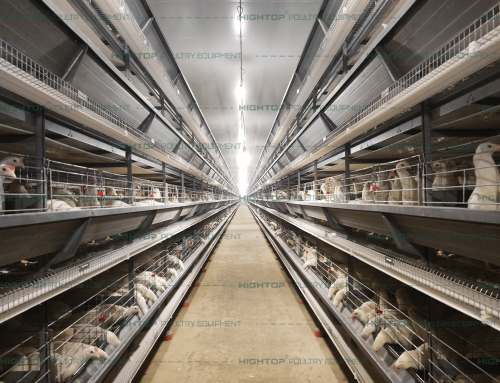
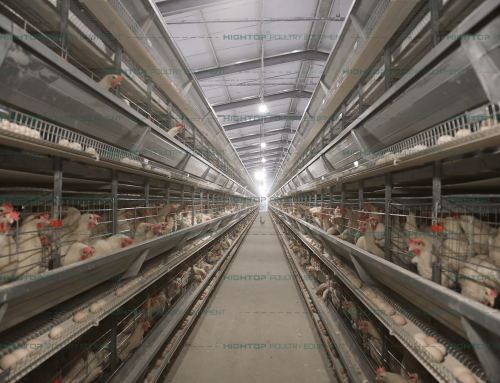
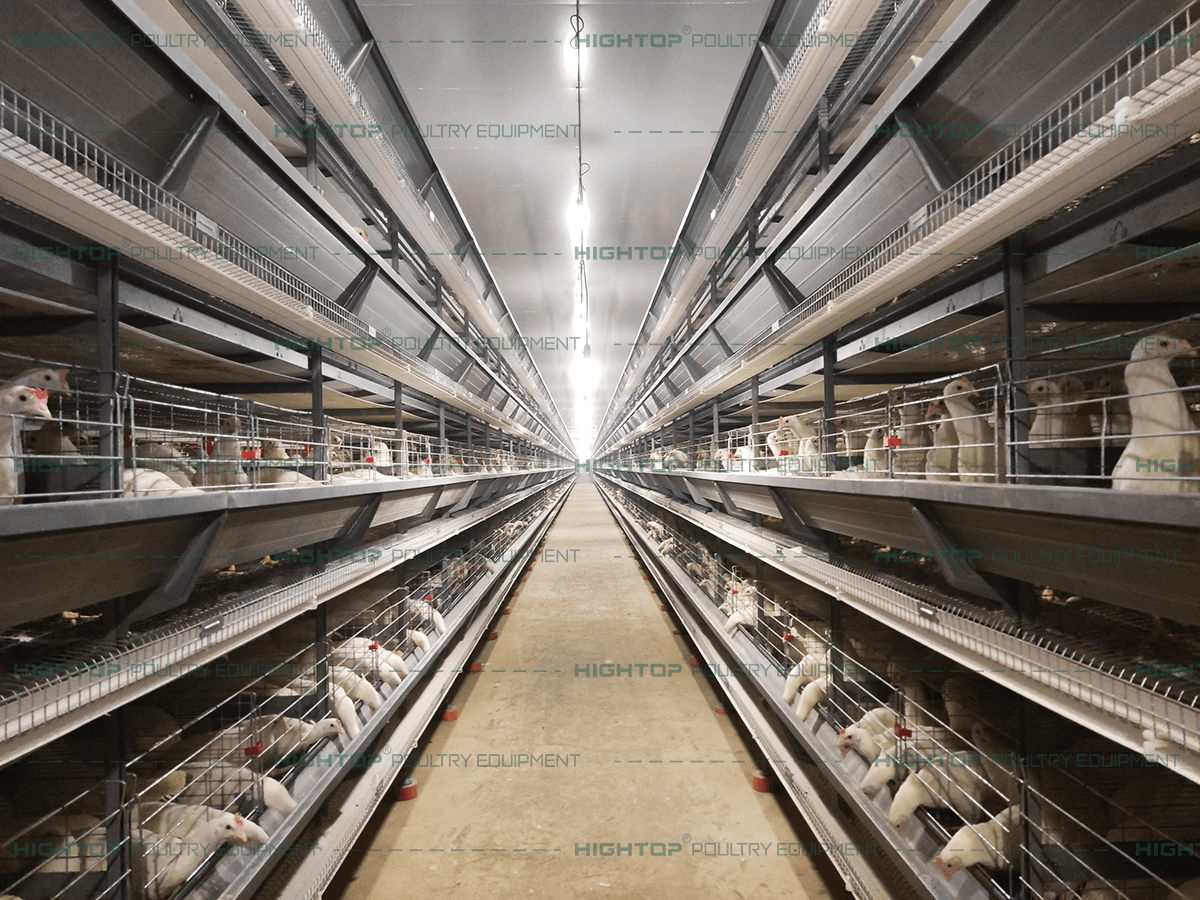
- 4-tier cage systems
- 6-tier cage systems
- 8-tier cage systems
With multiple cage levels, maintaining a uniform environment became significantly more difficult.
Many farmers discovered an unexpected problem:
Even when temperature readings appeared ideal, birds on different cage levels experienced completely different conditions.
Common examples included:
- Birds on upper tiers suffering heat stress
- Birds on lower tiers experiencing poor airflow
- Ammonia accumulation near bird level
- Uneven production performance between cage rows
This led to a fundamental shift in environmental management philosophy.
Modern Definition of Environmental Control
Today, environmental control is defined as:
Using the control and movement of air to properly distribute temperature, humidity, and air quality throughout the poultry house.
In other words:
We are no longer controlling temperature alone.
We are controlling airflow.
This is the beginning of the Airflow Control Era.
Part 2: Flat Ventilation vs. Vertical Ventilation
Traditional Flat Ventilation
Most conventional poultry houses use horizontal or flat ventilation.
Fresh air enters through sidewall inlets and moves horizontally across the house before exiting through exhaust fans.
This approach works reasonably well when birds occupy only one or two vertical levels.
Why Flat Ventilation Fails in Stacked Cage Houses
As cage height increases, horizontal airflow becomes increasingly ineffective.
Problems include:
- Air bypassing bird living zones
- Uneven airflow distribution
- Dead-air pockets
- Ammonia accumulation
- Temperature stratification
The upper tiers often receive excessive airflow while lower tiers receive very little.
As a result:
- Bird comfort decreases
- Disease risks increase
- Production consistency suffers
Why Vertical Ventilation Is Necessary
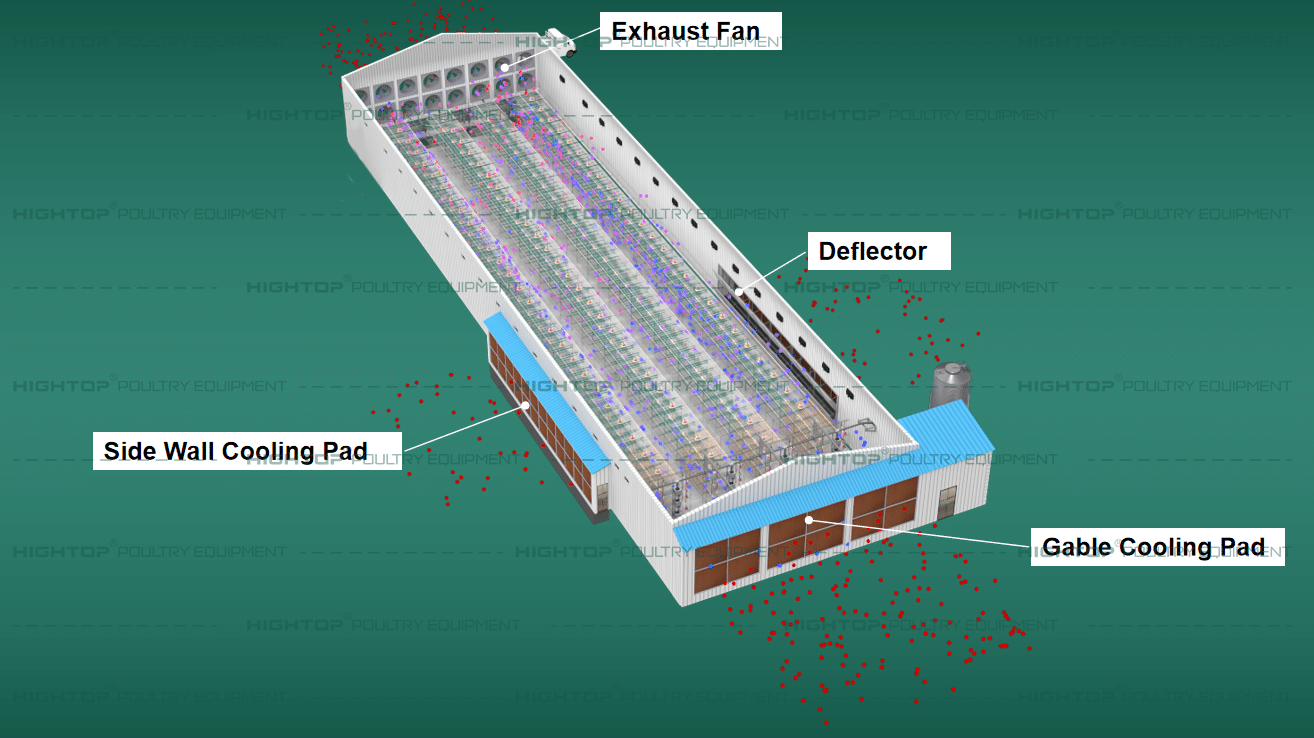
Stacked cage systems require airflow to move through every cage level.
This is known as vertical ventilation.
Instead of simply moving air across the building, vertical ventilation ensures fresh air reaches every tier.
Common designs include:
Bottom-to-Top Vertical Ventilation
- Air enters through lower sidewall inlets
- Air rises naturally through the cage structure
- Warm, humid air exits through roof or high-wall fans
Tier-Directed Air Supply
- Air tubes or deflectors deliver fresh air directly to each cage tier
- Air reaches birds more evenly
- Dead zones are minimized
Critical Factors in Vertical Ventilation
Successful vertical ventilation depends on balancing several variables:
Air Speed at Bird Level
Too high:
- Chilling
- Feed efficiency loss
Too low:
- Ammonia accumulation
- Poor air quality
Uniform Distribution
Every cage level must receive similar airflow volumes.
Static Pressure
Static pressure must be carefully controlled to:
- Pull air effectively through inlets
- Avoid excessive drafts
- Maintain airflow consistency
Without an intelligent controller, managing these variables becomes extremely difficult.
Part 3: Understanding Minimum Ventilation Rates
Why Ventilation Is Required Even During Winter
Many poultry farmers make the mistake of reducing ventilation excessively during cold weather.
However:
Birds continuously produce:
- Moisture
- Carbon dioxide
- Ammonia
- Heat
Fresh air is always necessary.
The challenge is determining the minimum ventilation rate.
Traditional Standards
Historically:
- Floor systems
- Step cage systems
used ventilation rates of:
0.5–0.7 m³/h per kg of body weight
Why Stacked Cage Houses Are Different
Larger Oxygen Utilization Zone
Floor systems:
- Approximately 60 cm oxygen zone
Step cages:
- Approximately 1.5 m oxygen zone
Four-tier stacked cages:
- Approximately 3.3–3.5 m oxygen zone
This dramatically changes airflow dynamics.
Greater Bird Density
Compared with floor systems:
- 2.2 times more birds
Compared with step cages:
- 1.8 times more birds
However:
The oxygen utilization volume increases significantly.
Using old ventilation standards would result in severe over-ventilation.
Daily Manure Removal Changes Everything
Modern H-type systems remove manure daily using manure belts.
Benefits include:
- Lower humidity
- Reduced ammonia production
- Less moisture accumulation
Because moisture loads decrease substantially, ventilation requirements also decrease.
Recommended Minimum Ventilation Rate
For modern stacked cage houses:
0.25–0.3 m³/h per kg of body weight
This provides:
- Adequate oxygen
- Acceptable ammonia levels
- Reduced heating costs
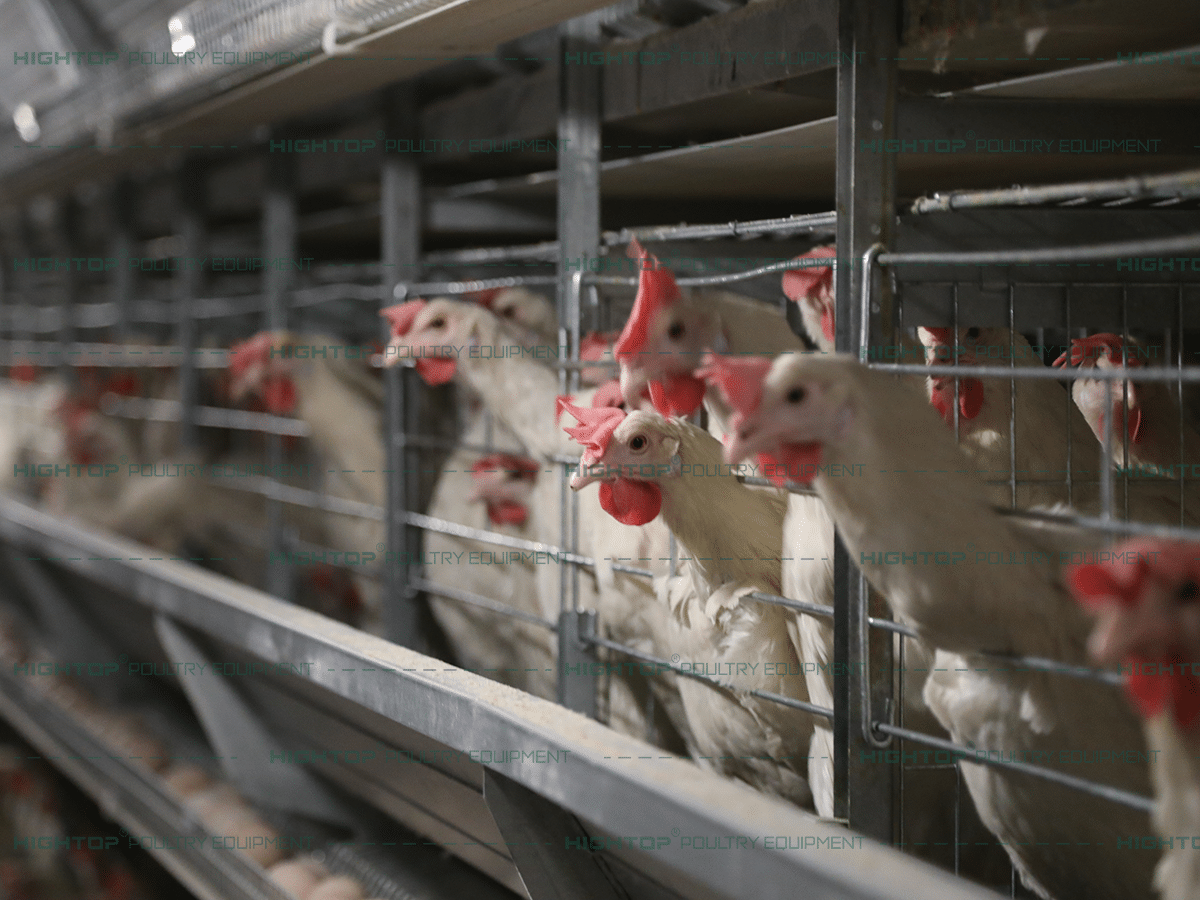
Part 4: Current Development of Environmental Control Technology
1. Precise Temperature and Humidity Management
Modern environmental systems utilize:
- Multiple sensors
- Real-time monitoring
- Continuous adjustments
Temperature fluctuations can often be maintained within:
±0.3°C
2. Semi-Automation Is Standard
Modern controllers allow farmers to preset:
- Bird age
- Bird weight
- Seasonal requirements
- Ventilation curves
The controller then adjusts equipment automatically.
3. Environmental Physics Has Been Quantified
Years of field testing have established practical relationships:
- Every 7°C temperature difference = approximately 1 Pa static pressure adjustment
- Every 5% humidity difference = approximately 1 Pa static pressure adjustment
These relationships allow precise airflow management.
4. Remote Digital Farm Management
Cloud-based systems now provide:
- Mobile monitoring
- Alarm notifications
- Historical trend analysis
- Remote expert support
This has become the new industry standard.
Part 5: Why the Smart Controller Is the Brain of Vertical Ventilation
Intelligent: Understanding the Entire Poultry House
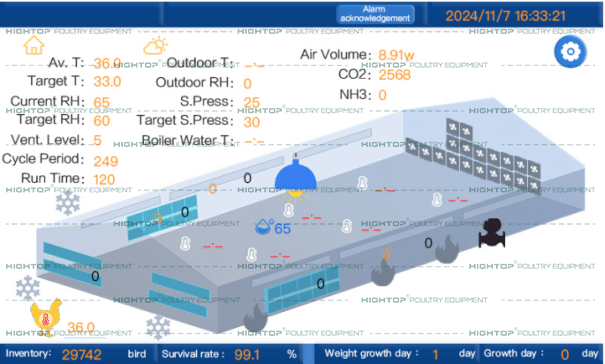
A smart controller continuously monitors:
- Indoor temperature
- Outdoor temperature
- Humidity
- CO₂
- Ammonia
- Static pressure
- Air speed
It identifies developing problems before they impact bird performance.
Efficient: Lower Energy Consumption
Modern controllers optimize:
- Fan operation
- Ventilation rates
- Seasonal strategies
Energy savings of:
15–30%
are commonly achieved.
Convenient: Farm Management Anywhere
With cloud connectivity, farmers can:
- View real-time conditions
- Modify settings
- Review historical trends
- Receive instant alarms
from any location.
Precise: Eliminating Guesswork
Precision means:
- Temperature within ±0.3°C
- Ammonia below 10 ppm
- Stable static pressure
- Optimized airflow distribution
The result is healthier birds and more consistent production.
Part 6: HIGHTOP Controller Advantages – Built for Real Poultry Farms
PLC Touch Screen with Fool-Proof Operation
Many environmental controllers are overly complicated.
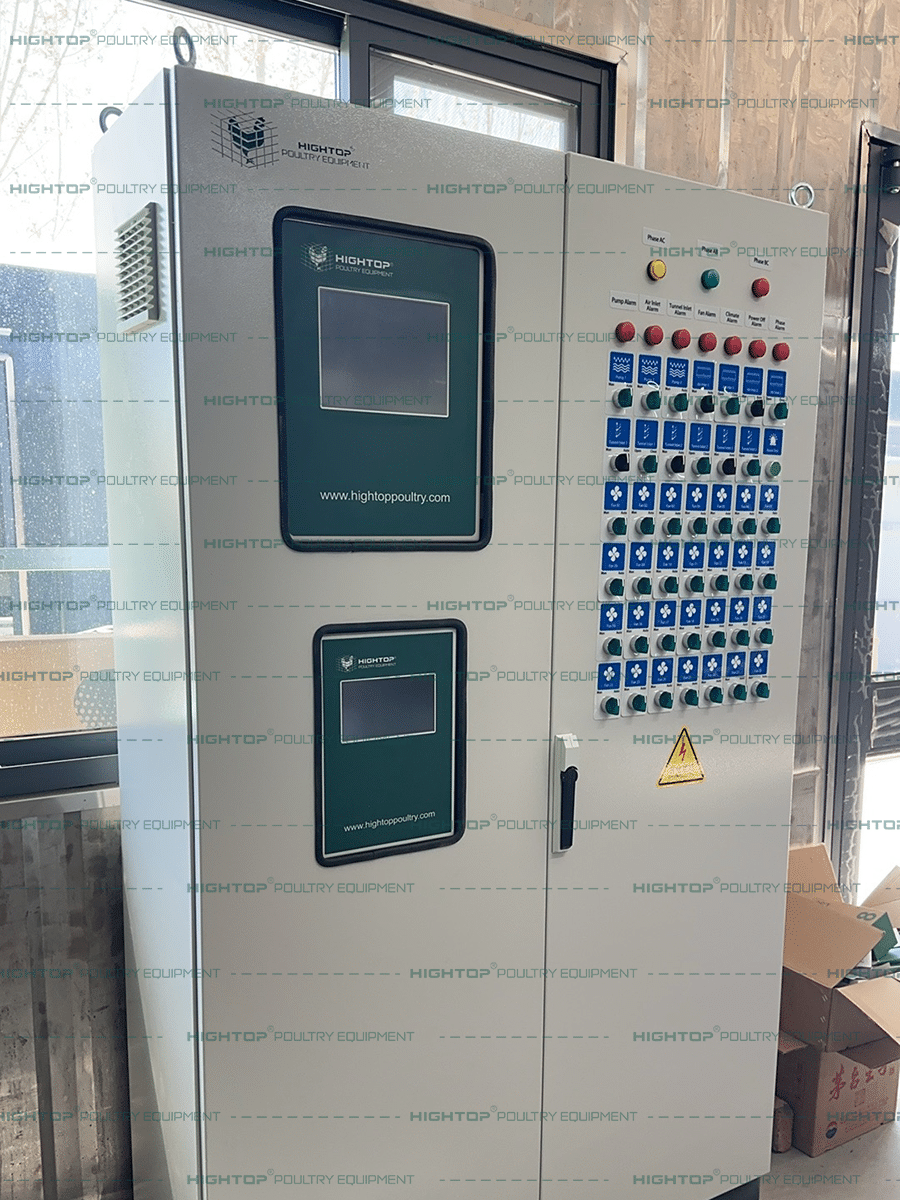
The HIGHTOP controller uses an intuitive PLC touch screen interface that allows operators to quickly learn system operation.
Users simply enter:
- Chicken breed
- Bird age
- Average body weight
- Season
- Outdoor temperature
- Wind speed
The controller automatically calculates operating parameters.
Intelligent Logic Incorporating Chicken Body Temperature
Most controllers only monitor air temperature.
HIGHTOP goes further.
It also considers:
Chicken body temperature
This provides a more accurate understanding of actual bird comfort.
Lighting-Based Temperature Compensation
When lights are off:
- Bird activity decreases
- Body temperature drops
The controller automatically adjusts temperature targets.
When lights are on:
- The system allows birds time to resume activity
- Temperature targets gradually return to normal
These small adjustments significantly improve bird comfort and feed efficiency.
Industrial-Grade Hardware Reliability
Poultry houses present harsh conditions:
- Ammonia
- Dust
- Humidity
- Voltage fluctuations
The HIGHTOP controller is designed specifically for these environments.
Enhanced Lightning Protection
Typical controllers: 3000–4000V protection
HIGHTOP controller: 6000V protection
Extended Warranty
Most controllers provide: 1-year warranty
HIGHTOP provides: 3-year warranty
For large-scale poultry farms, controller reliability directly protects production and profitability.
Conclusion: The Future of Poultry Environmental Control Is Airflow Management
The poultry industry has evolved far beyond simple cooling systems.
Modern stacked cage layer houses require:
- Proper airflow paths
- Uniform air distribution
- Precise ventilation control
- Intelligent environmental management
A properly designed vertical ventilation system combined with a smart controller can:
- Improve bird health
- Reduce energy costs
- Lower mortality
- Reduce medication expenses
- Extend laying cycles
- Improve farm profitability
The HIGHTOP intelligent controller brings together advanced airflow management, bird-focused control logic, easy operation, and industrial-grade reliability.
The future of poultry environmental control is not simply keeping houses cool.
It is controlling airflow intelligently.
And that future is already here.